Any Internet search for Kyushindo Karate history often mentions the influences of Chinese martial arts, such as Hsing-I, Bagua, and Tai Chi, on its development, which had a Shotokan base.
Kyushindo Karate, in most areas, includes a technique called Circle Walking or Chinese Walking. This technique is based on the Bagua Circle walking, but unlike Bagua it uses the ‘rolling step’—heel to toe, rather than ‘mud-step’.
At one of the Banstead classes, Martin demonstrated a single palm change from Bagua while we were practising the Circle Walking exercise, which piqued my curiosity. He learnt it from some Chinese Boxers who used the same venue while training in Bristol.
A palm change is a formalised sequence of movement/techniques to change direction when walking the circle. In Bagua forms, there are usually eight different palm changes. The first of these is generally called the ‘single’ palm change.
When I moved to Hampshire in the mid-90s, I tried to find some Bagua classes or instructors but with little success. Around 2000, I found a class running in Petersfield by Aarvo Tucker, and I went to the sessions for a couple of months before he announced that he was moving back to Canada. As a beginner doing the basic exercises, I didn’t pick up much from the sessions, which seemed mainly focused on applications with little instruction of forms. This wasn’t surprising, as he had also trained in Hsing-I.
I then found a class in Crowthorne, Berkshire and attended the monthly Saturday sessions held on a patio at the instructor’s house. The instructors were Karel and Eva Koskuba, who had formed the Chinese Internal Arts Association (CIAA). They specialise in Chen-style Tai Chi, Chi Kung, and Yiquan, but they have also learned Bagua and Hsing-I with their various instructors. Over the next 3 years, they had multiple moves around Berkshire before settling in Swallowfield, and most of the lessons during this time took place in Palmer Park, Reading.
I joined a group who were all well progressed in learning the main form, and I started to learn this form (Jiang Rongqiao’s) and once I had learnt most of that, they then went back to teaching their more straightforward training form, which they called the ‘Dragon form’ (based on Old Fu style of Fu Chen Sung)
The books below describe and illustrate the forms they teach. The main form is widespread, and numerous variations are showcased on YouTube. However, as far as I can see, the ‘Dragon Form’ is nonexistent on YouTube.

As with most internal style teaching in the West, their emphasis is on forms, but there is a lot of focus on whole-body movement compared to what you usually get in a standard Tai Chi class here. They do not mention ‘chi’ as an intangible force, preferring to describe it as internal power cultivated by the alignment and coordination of the whole body and will. They also promote the idea that the postural muscles, rather than the phasic muscles, give internal power.
Has it helped with my Karate training? In some ways, yes, particularly in the flow and precision of movement. Some walking techniques, such as ‘mud-stepping,’ are probably impractical. I like the compact nature of the forms (need some room for Tai Chi) and the intricate, satisfying movements. Teaching circle walking to Karate students has a ‘marmite’ effect—some like it, some hate it or don’t see the point.
I can see that Bagua has influenced Kyushindo Karate by incorporating many avoidance and circular techniques, which are not found in mainstream Japanese Karate. In my Karate journey, I try to integrate whole-body movement principles into everything.
I have added a ‘simple palm change’ to my instruction for Circle walking at Romsey. This is shown on the Romsey training DVD, as ‘inside’ and ‘outside’ change of direction.
(I am happy to teach Bagua palm changes to anyone who wants to learn them)
Around 2004, I taught the main form to James Allenby, who learnt it in about 2 hours total which was typical with his almost ‘photographic’ memory for katas, forms and techniques once shown. At James’s ‘dojo’ (in Ower), I also taught Paul Clayson, a Judo and Karate instructor from the Oxford Kyushindo area, the first four palm changes, who came down on Friday evenings for a while.
The first session nearly didn’t happen – I had invited Paul, after he expressed an interest to learn after viewing the Romsey DVD, and he wanted to bring Mike James with him down to James’ dojo. I had mentioned it to James a couple of weeks prior, but I didn’t follow up and confirm with him as we missed a week out during our usual weekly session. In the evening, I knocked on James’ door, with Paul and Mike in tow, and there was a big party going on – luckily, it was mostly his girlfriend’s side in attendance, so he managed to get away and open the barn, and he also chose to attend; a bit worse for a drink.
Lesson learned: confirm arrangements.
I decided to stop attending the Saturday Bagua classes when my daughter was born in 2003, though for a further year, I went to an occasional weekly class in the evening when I worked in nearby Basingstoke. I returned to the monthly Saturday training in 2019 at Swallowfield.
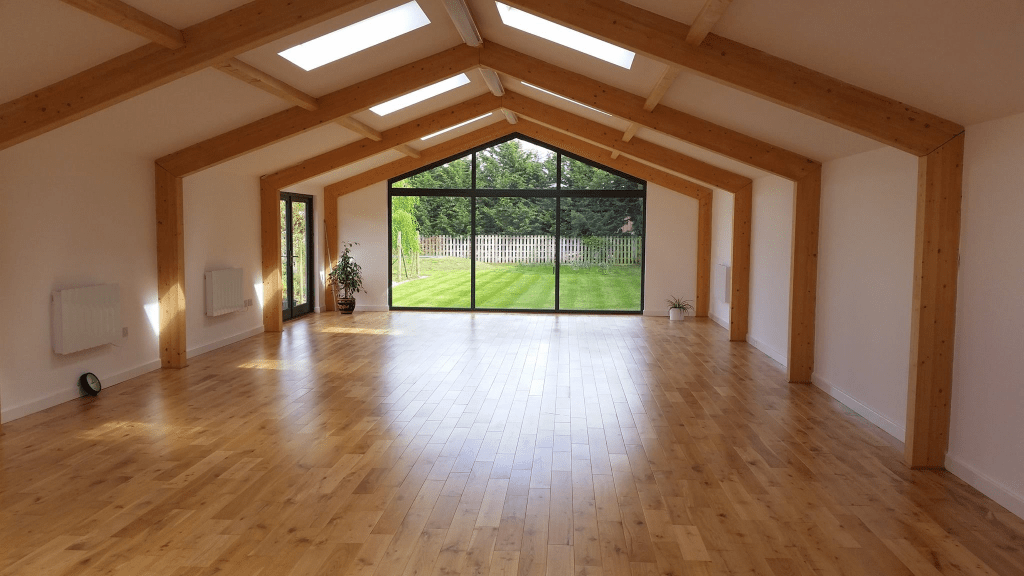
During the COVID-19 lockdown, they stopped the monthly classes and started weekly 8:30-9:30 Zoom classes. They have continued on Saturdays to this day, unfortunately sometimes causing late attendance at the Romsey club if traffic is bad from my home in Fair Oak. If I have a Thursday off in summer, I sometimes attend their Bagua class from 5:30 to 6:30 pm in the studio (or garden) at their Swallowfield house.
 Life Style
Leave a comment