This is the first of my technical posts on pressure points.
1. Gall Bladder meridian cluster of GB-13, GB-14, GB-15
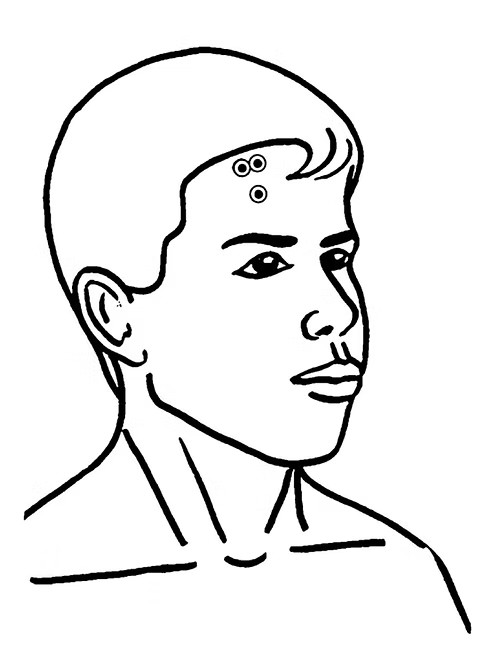
These points are struck with a heavy open hand, either using one arm or, better, because the points are symmetrical on the other side of the head, you can add your other arm to strike both sets.
This is a stun point. It should give you 5-6 seconds of confusion, allowing you to escape.
I used to train this while wearing a head guard. After grabbing the student by the lapels, they would do a double-hand strike to these points. However, they got too good at this—even with my head guard—and after experiencing a few seconds of confusion, I developed a headache later in the day, so I stopped doing it.
One advantage of using this technique in self-protection is that it addresses the limitations of physical confrontation that many individuals face. The psychological hurdle that comes with punching someone in the face should not be underestimated when teaching decent, moral human beings.
If it is viewed as a hard push, there is significantly less inhibition to strike, and it also appears less aggressive than a punch if caught on CCTV.
This technique is promoted as ‘Body Alarm Reaction’ by some organisations, particularly the ‘Dragon Society International’ and its instructor offshoots, such as Russell Stutely.
2. Gall Bladder meridian GB-20

In the posterior aspect of the neck, below the occipital bone, in the depression between the upper portion of the sternocleidomastoideus muscle and the trapezius muscle. (See why GB-20 is easier to remember.)
This is a knockout point, usually with a ridge hand — inner or outer.
This is the classic knockout point used at Pressure Point seminars to impress. One hand strikes at the GB cluster whilst the other strikes at GB-20 on the diagonally opposite side of the head at the same time.
 Life Style
Leave a comment