The points mentioned in this post are deemed dangerous. Do not play around with them.
5. Small Intestine Meridian point 17 (SI-17)
Posterior to the angle of the mandible, in the depression on the anterior border of the sternocleidomastoideus muscle and the inferior margin in the posterior belly of the digastric muscle.
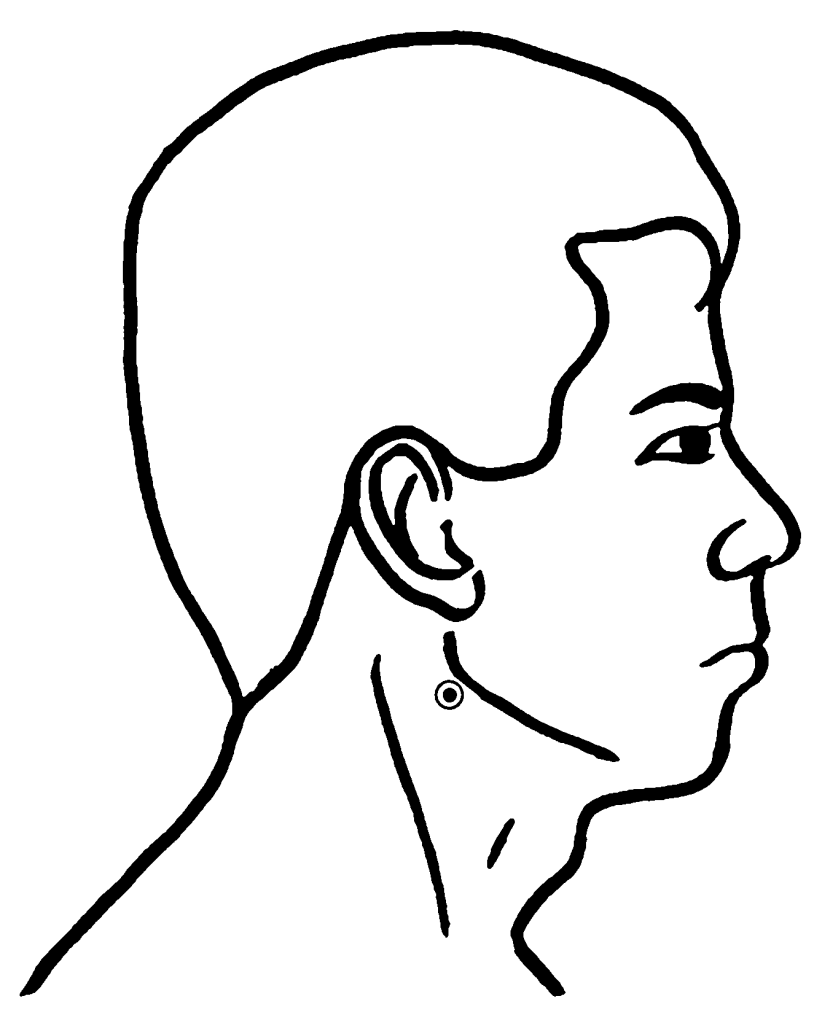
This is one of the widely classified deadly points. It is very close to the vagus nerve and will cause a knockoutquite easily, and it is right over the external carotid artery.
Attacking this point is done with the classic karate chop, particularly using an outer chop; however, the slower and less sneaky inner chop (the chop like throwing a ball) can also be used.
Outer chop diagram:
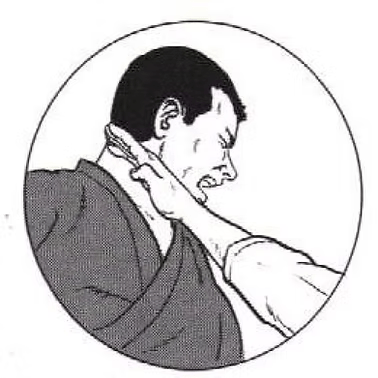
However, other organisations, such as ‘Target Focus Training’, will aim to place a forearm into the neck to attack this point (and other nearby points). Basically, you step forward with the arm at an angle (a bit like a ‘half-rising block’ for Kyushindo practitioners) and strike the neck—a very dangerous yet relatively easy technique to perform, requiring minimal training.
6. Stomach Meridian point 9 (ST-9)
This is probably the most notorious point in the martial arts; it is widely demonstrated and potentially very dangerous.
Level with the tip of the Adam’s apple, on the course of the common carotid artery, at the anterior border of the sternocleidomastoid muscle.
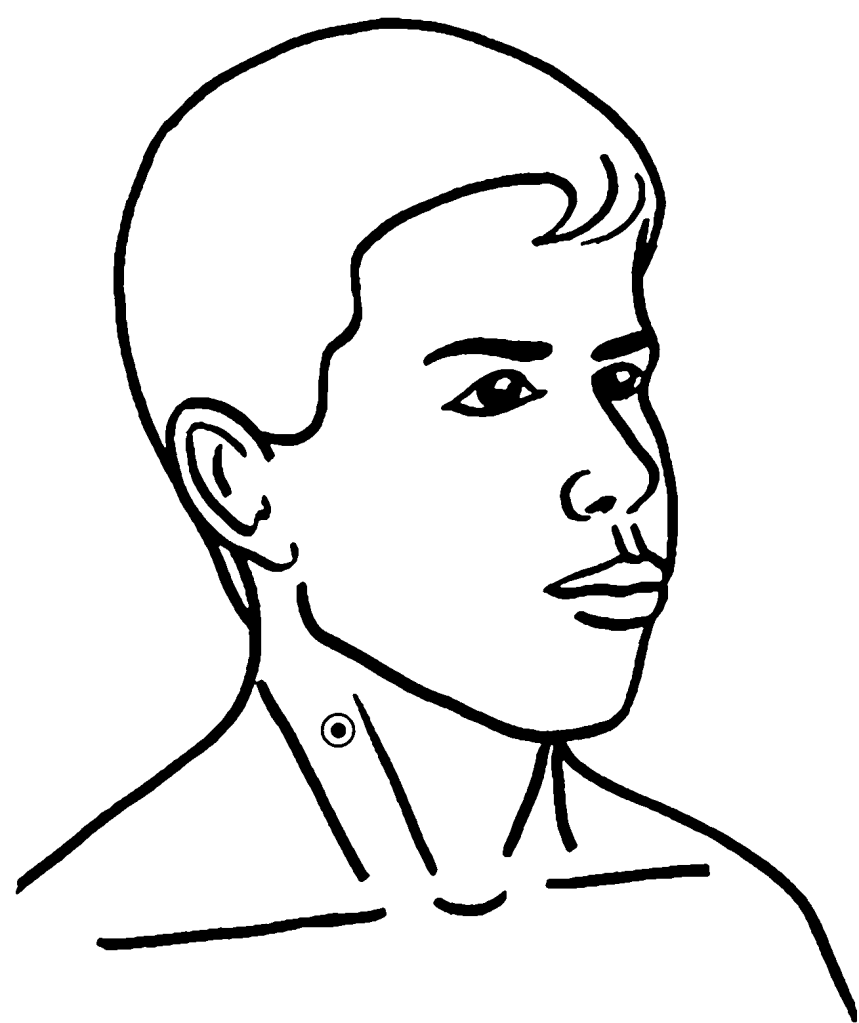
ST 9 is one of the major Dim-Mak points. It is easy to get to; its effect is devastating, ranging from a knockout for a light blow to death for a heavy blow. ST 9 is situated right over the carotid sinus. The carotid sinus is a baroreceptor that detects an increase in blood pressure. When it detects this increase, it sends a signal via the vagus nerve, of which it is a part, to the vasomotor centre of the brain, which initiates a vasodilatation and slowing of the heart rate to lower the blood pressure to normal.
Carotid Sinus Reflex: The martial artist is concerned with a phenomenon called the carotid sinus reflex, which is the decrease in heart rate as a reflex reaction to pressure on or within the carotid artery at the level of its bifurcation.
Carotid Sinus Syndrome: This is a temporary loss of consciousness or a knockoutthat sometimes accompanies convulsive seizures because of the power of the carotid sinus reflex when pressure builds up in one or both carotid sinuses. This syndrome can be artificially induced by striking the area of the carotid sinus, specifically ST 9.
In striking ST 9, we fool the brain into believing that deadly high blood pressure is present, so the blood pressure is dropped, causing a faint.
Other people have knocked themselves out when they have turned their head suddenly because of a hypersensitive carotid sinus, and tight restrictive costumes around the neck have caused some sensitive actors to faint on set.
In the 1980s, some martial artists discovered that they could easily knock out by striking this part of the neck; however, no one knew why the knockout occurred. Nor did they know the dangers of such strikes, usually done to show what good martial artists they were, purely for ego.
Hitting an artery with a lot of power is never a good idea due to potential damage, and there is some risk of low-power strikes dislodging arterial plaques, increasing the risk of strokes in the future.
A strike to the side of the neck can potentially cover both of these points (and others not mentioned), which is why it is most effective and often at the top of many self-protection organisations’ lists of targets. It is sometimes referred to as a ‘brachial stun’.
 Life Style
Leave a comment