I want to look at the Point of Impact.
A hand strike should impact when it is travelling with maximum velocity. If we look at a standard karate reverse punch starting from the hip, what is its velocity over distance?
The issue has been investigated; a couple of references, ‘Dynamic Karate’ by Master Nakayama and J.D. Walker – Karate Strikes (1975 – American Journal of Physics), agree on their results.
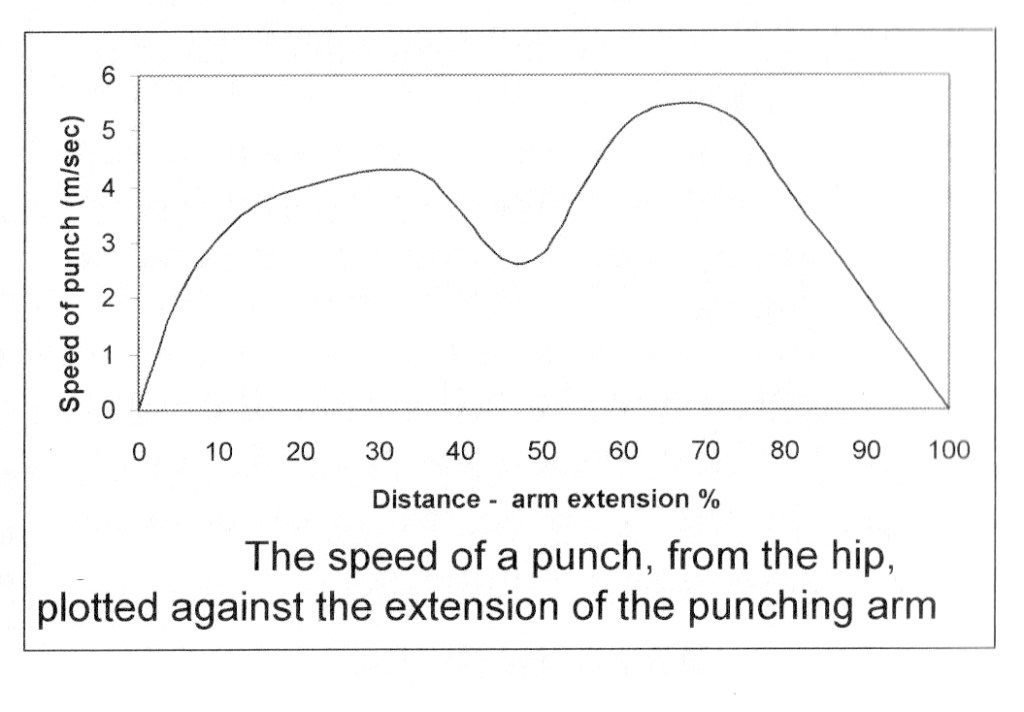
From the graph we can see that the maximum velocity (and hence power) is around 70-75% of the arm extension.
There are some points to note or conclude:
- In karate, the fist will not have been rotated to the normal finishing position when training “air punching.”
- Some karate styles apply focus or muscular tension only at the full extension point.
- Punch through the target; don’t aim for the surface.
Is there some adaptation required for these first two points? I think the answer can be found in training and by striking punch bags.
In my Kyushindo training, I don’t emphasise muscular tension at the extension points. I tend not to use the classic karate fist when punching with power; I prefer a vertical fist. I always aim to strike inside of the opponent – penetration.
Many styles emphasise tension over speed because they say they’re trying to cause damage rather than score points. However, movement and body structure can reduce tension while sustaining damage.
The other aspect of impact is the area that the strike is covering. A classic clenched fist has a relatively small area of impact when compared to an open hand (palm heel strike). There may be a more penetrative effect from a fist, and the likelihood of knockouts and damage increases over open-hand strikes.
Pressure = Force / Area
If we assume the area of the hand is 20 square inches and you slap with 450 lbs of force, then you are generating 22.5 pounds per square inch. (450 / 20)
If we assume that two knuckles have an area of 0.4 square inches, then the pressure now increases to 1125 pounds per square inch. (450 / 0.4)
However, in the world of self-protection, the aim is also not to injure oneself, so the open hand or some other fist variation (vertical fist or hammer fist) is preferred. You impart less than maximum damage, but you are much less likely to break yourself.
The reason why boxing gloves are worn in boxing is not to protect your hands from injury (that’s more the tape wrap) but to prevent serious injury to the opponent that would occur with bare knuckles – the glove increases the impact area. There are a few tales of boxers having to use self-protection, only to have broken their hands. Elite training is not guaranteed protection from injury.
This post has mostly looked at long range; in the future I will look at short-range technique.
 Life Style
Leave a comment